
The 5:47pm moment every parent knows
It is 5:47pm. You have said 'five more minutes' three times. Your child heard none of them.
Now you are crouched by the swings, voice low, trying to reason with a small person who has just discovered that the world is ending because playtime is over. Other parents are watching. Your child is screaming, or crying, or has gone limp and boneless in the specific way toddlers do when they want to become impossible to carry.
You are not doing anything wrong. This is one of the most common flashpoints in early childhood, and it has almost nothing to do with discipline.
The problem was never the tantrum
Most parenting advice treats the park meltdown as a behaviour problem to be managed. Stay calm. Give a warning. Offer a reward. Hold the boundary. All sensible, and all missing the actual issue.
Young children do not yet have the wiring to shift gears quickly. Going from full joy, the wind in their hair, the freedom, the friends, straight into 'get your shoes on, we're leaving' is not a small ask for a developing brain. It is a sudden stop after a full sprint. The tears are not manipulation. They are what it looks like when a big feeling has nowhere to go.
That is why the usual tricks stop working after a while. A countdown gives a warning, but it does not give a child anywhere to put the feeling that comes with the ending. So the meltdown still happens. You just get a five minute preview of it first.
What actually helps: giving the feeling a job to do
Here is the shift that changes everything. Instead of trying to stop the big feeling, you give it somewhere to go.
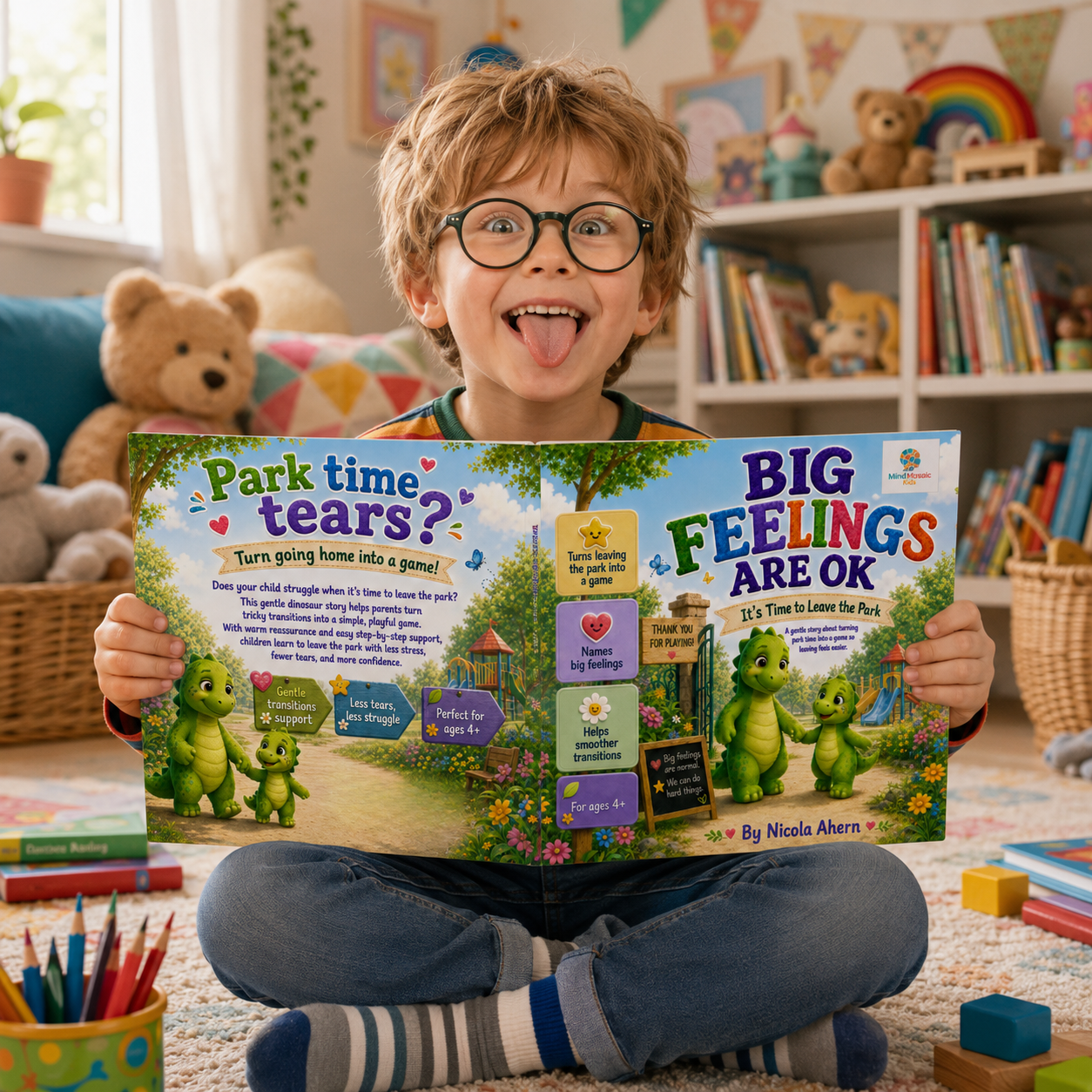
That is the whole idea behind a new picture book, Big Feelings Are OK: It's Time to Leave the Park, written and illustrated by Nicola Ahern.
It follows Ash, a small, bouncy dinosaur who loves the park more than anywhere in the world. Slides, puddles, swings, all of it. And like every small child, Ash has absolutely no interest in going home when the fun is at its best.
When Mum Dinosaur says it is time to go, Ash's happy feeling 'goes wobbly.' Arms fold. Feet stamp. A hot, fuzzy feeling curls up in his tummy. It is every parent's 5:47pm, just with a tail.
But instead of rushing him or bribing him out the gate, Mum does something simple. She turns leaving into a game.
The Going-Home Game
The book walks children through five small, doable steps that turn the worst part of the day into something they can actually take part in:
1. Pick one last thing to do. Just one. Giving a child a final go on the slide, rather than an abrupt stop, closes the moment instead of cutting it off.
2. Say goodbye to the park. Out loud, together. Naming the ending makes it real in a way a child can hold onto, rather than something that just happens to them.
3. Hand them a job. Ash becomes 'Captain of the Way Home.' Suddenly leaving is not something being done to him, it is something he is in charge of.
4. Ask what they loved. One good thing from the visit, said out loud, turns the walk to the car into a highlights reel instead of a funeral march.
5. Talk about next time. A plan to come back is a promise, and promises are easier to leave on than full stops.
None of it rushes the feeling away. Mum never tells Ash he is being silly, or that it is not a big deal. She simply says, 'That big feeling is your heart saying, I loved this.' Then she gives him a way through it.
Why this works better than another countdown
This book was not written to be read once and admired. It is designed to be read again and again, ideally on the sofa on a calm afternoon, until the Going-Home Game becomes familiar. Once a child knows the steps, you can bring them to the actual park. 'Shall we do the Going-Home Game?' lands very differently to 'we need to leave now,' because it is not a command. It is something they already know how to do.
That is the real shift. You are not fighting the big feeling at the gate anymore. You gave your child a tool for it before you ever got there.
Who it is for
Big Feelings Are OK: It's Time to Leave the Park is written for children aged four and up, and for the parents standing next to them at 5:47pm wondering if this is ever going to get easier.
It is part of the wider Big Feelings Are OK series, all built around the same simple belief: big feelings are not something to shut down. They are something children can be shown how to move through, one gentle step at a time.
If leaving the park, or the swimming pool, or a friend's house, or the iPad, has become the hardest ten minutes of your day, this book will not stop your child from having big feelings. Nothing will, they are children. But it will give both of you somewhere to put those feelings that is not a screaming match by the gate.
Grab a copy, read it once when things are calm, and next time the sun starts dropping and the shadows get long, you will both already know what to do.
The Solution
Gentle tools to try tonight
Pair one story with one printable and you have the whole shape of this article on the sofa with your child.
Books that rehearse the moment
It's Time to Leave the Park
Buy the book →Big Feelings Are OK (toddler boys)
Buy the book →Big Feelings Are OK (toddler girls)
Buy the book →
Free printables to go with it
Downloads unlock the moment you pop your email in - one form, then the PDF lands in your inbox.
- Download the printable →
Gentle Transition Cards
Six illustrated cards to help little ones move from one activity to the next.
- Download the printable →
SEN Transition Notebook for Parents
A guided notebook for moving through school, setting or life transitions together.
This article is general parenting support, not medical advice. If you're worried about your child, please speak to your GP or health visitor.